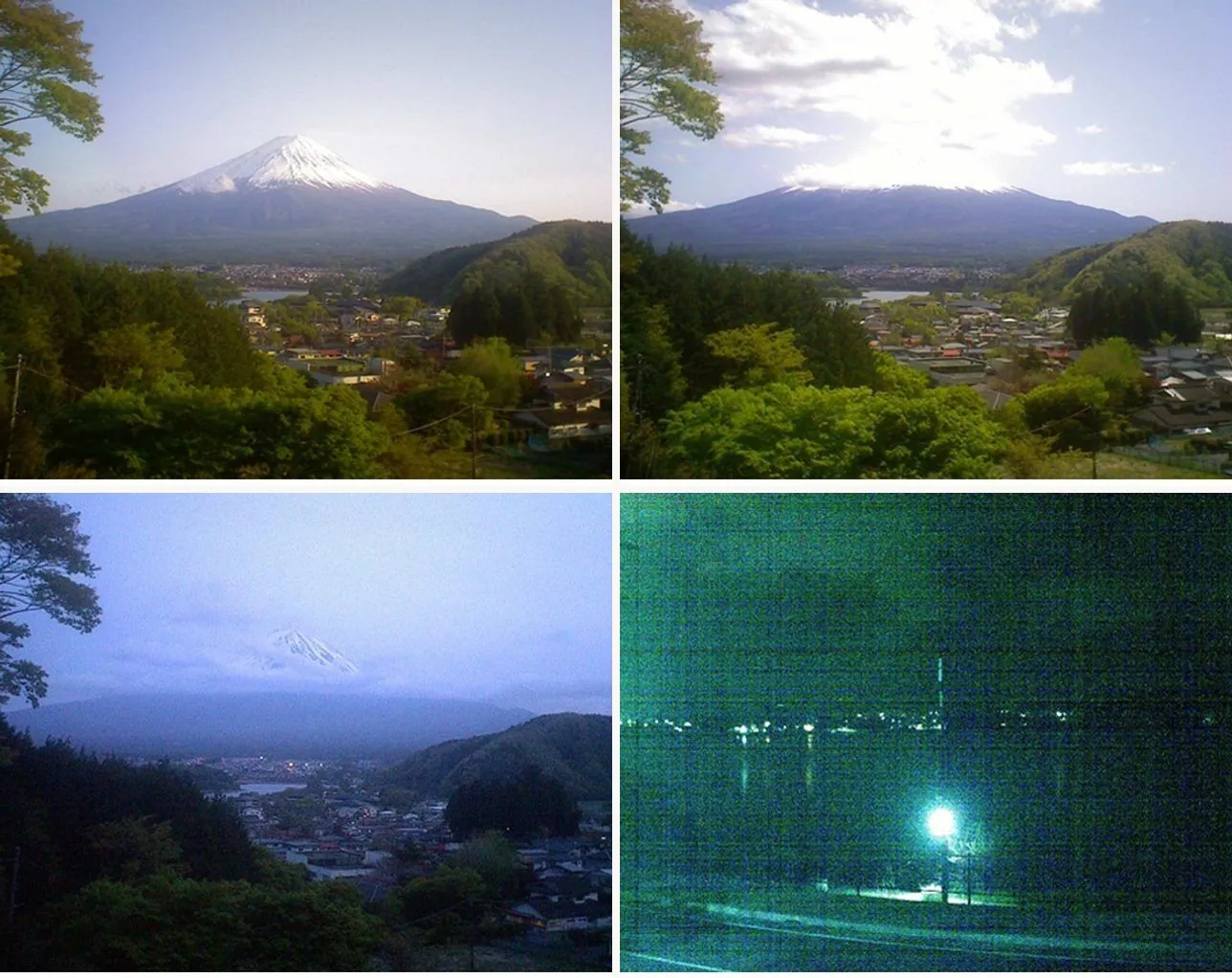
FujiView
Will you see Mount Fuji tomorrow? FujiView fuses live webcam imagery with weather data to forecast scenic visibility — published at WACV 2026.
Research
AICIP studies how machines extract reliable information from imperfect, distributed, and multimodal observations — a question the lab has pursued from wireless sensor networks in the early 2000s to today's foundation models for remote sensing and adaptive AI for health.
How should a model combine what a camera sees with what a weather station measures? When should one modality overrule another? AICIP studies principled fusion — late fusion across prediction horizons in FujiView, multi-objective masked image modeling in MEDiC and ExPLoRe, and cross-scale consistency in Cross-Scale MAE — along with the self-supervised pre-training that makes these systems work when labeled data is scarce.
Vision has been AICIP’s home ground since the lab’s founding: from automatic target recognition and smart-camera networks through face analysis (including the widely used UTKFace dataset) to today’s transformer-based recognition, detection in industrial inspection, and generative approaches to inverse problems. Dr. Qi has co-authored two Cambridge University Press textbooks on the subject.
FujiView · Hyperspectral Imaging · EcoCAR · Precision Agriculture · Representation Learning · UTKFace
A signature strength of the lab. AICIP’s hyperspectral work — unmixing, super-resolution, anomaly detection — earned the IEEE Geoscience and Remote Sensing Society’s Highest Impact Paper Award and continues today with generative approaches to nonlinear unmixing. Recent work extends to global-scale satellite change detection (IARPA SMART) and self-supervised pre-training tailored to the multi-scale nature of overhead imagery.
Hyperspectral Imaging · Representation Learning · IARPA SMART
The lab applies vision, reinforcement learning, and agent-based AI to care settings: adapting a virtual-reality music intervention to a person with dementia in real time, training socially assistive robots to respond to cognitive and emotional state, and building air-quality alert systems for at-risk homes. This work spans collaborations with UT engineering and nursing partners at Duke, supported by the NIH National Institute on Aging.
If training is a trajectory through weight space, can we predict where it’s going? The lab uses Koopman operator theory to model training dynamics — predicting weights several epochs ahead to accelerate optimization (PDT, ICLR 2026), stabilizing proximal policy optimization (KIPPO, IJCAI 2025), and measuring when and where training is structured enough to be predictable at all.
AICIP’s methods increasingly drive domain science and engineering: the ATHENA testbed applies AI to automated materials discovery as part of a national cloud-laboratory network; USDA-funded collaborations monitor poultry welfare and dairy-herd health with low-cost vision and IoT sensing; and the lab advises UT’s EcoCAR team, continuing a line of radar–camera fusion research for connected and autonomous vehicles.
Active projects
Will you see Mount Fuji tomorrow? FujiView fuses live webcam imagery with weather data to forecast scenic visibility — published at WACV 2026.
Music intervention in virtual reality that adapts to a person with dementia in real time — with reinforcement learning and AI agents driving socially assistive robots.
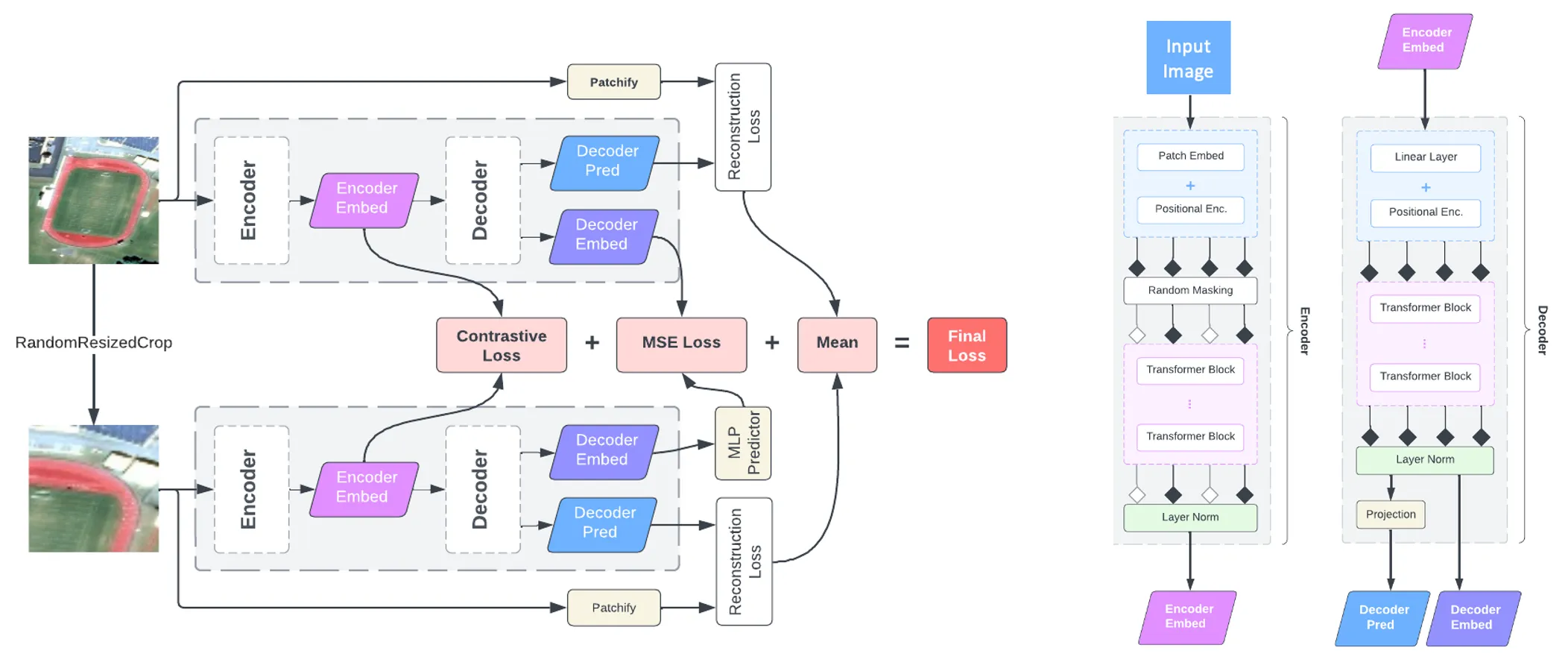
From Cross-Scale MAE to ExPLoRe — a sustained line of work on learning visual representations without labels, published at NeurIPS 2023 and ECCV 2026.
Lineage
Two decades of results the current work builds on. These threads still shape how the lab approaches new problems.
The “CIP” in AICIP. Through the 2000s the lab developed mobile-agent-based collaborative processing for wireless sensor networks — moving computation to data rather than data to computation — with applications from target classification to distributed smart cameras. This work, begun under DARPA’s SensIT program, earned Dr. Qi’s elevation to IEEE Fellow for contributions to collaborative signal processing in sensor networks, and its distributed-inference mindset persists in the lab’s current work on fusion and collaborative autonomy.
The “AI” in AICIP predates the current meaning of those letters: advanced imaging. Dr. Qi’s dissertation built a high-resolution, large-area digital imaging system, and the lab’s early years spanned medical imaging (thermal-image-based breast cancer analysis), automatic target recognition, and distributed smart-camera networks — including an award-winning line of work at the ACM/IEEE International Conference on Distributed Smart Cameras.